
Stachytarpheta cayennensis
-
Home
-
Browse collectionBrowse collection
-
Stachytarpheta cayennensisStachytarpheta cayennensis
Share:
Move your mouse over image to enlarge
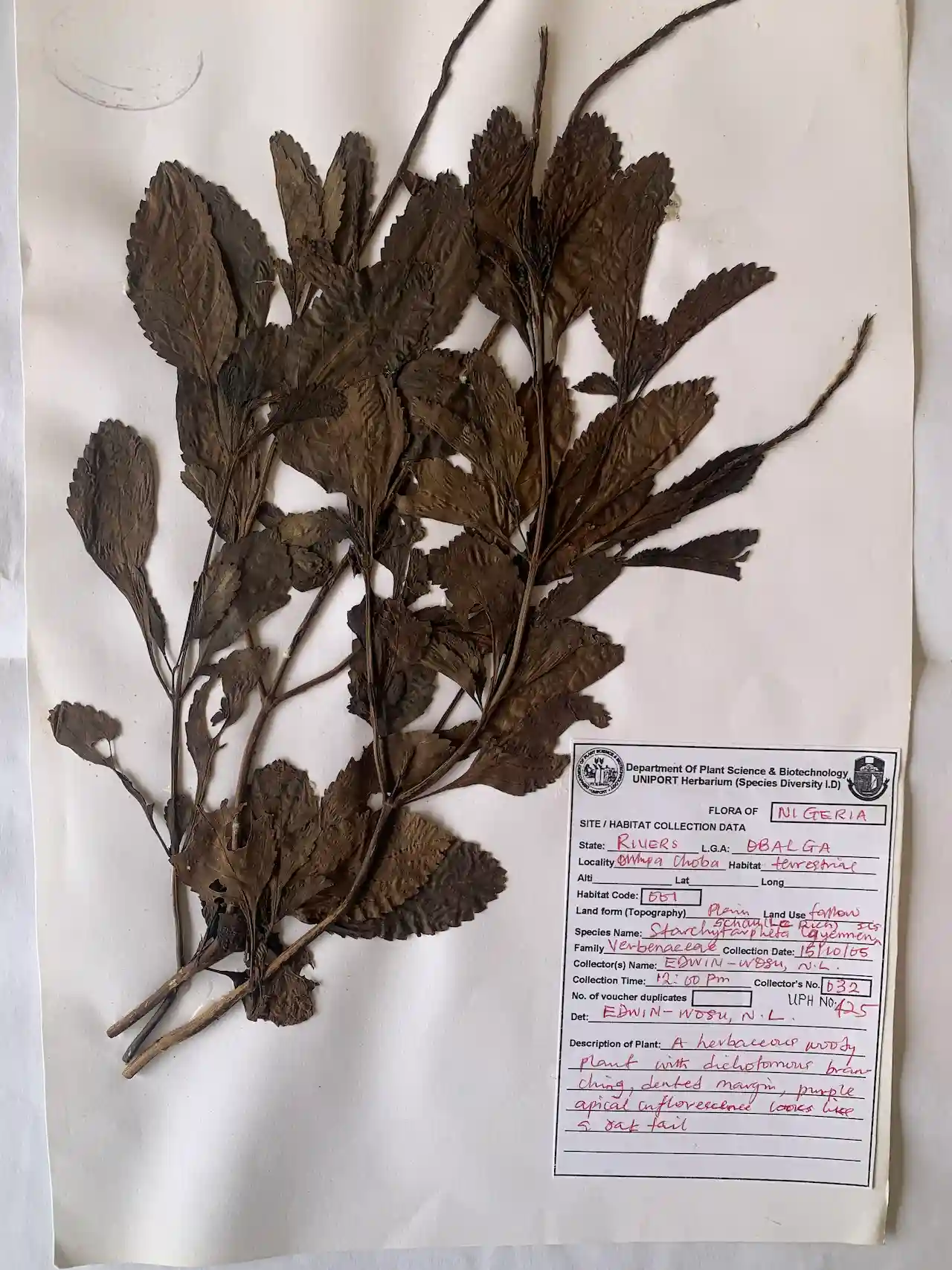
- Herbarium No: UPH NO. 425
- Stachytarpheta cayennensis
- (Rich.) Vahl
-
Botanical Name/Scientific Name: Stachytarpheta cayennensis
-
Genus: Stachytarpheta
-
Synonym: Stachytarpheta fallax A.E.Gonç.
-
Common/Local Name(s): Cayenne Porterweed, Blue Porterweed, or Blue Snakeweed.
-
Family: Verbanaceae
-
Botanical Description: Stachytarpheta cayennensis is a perennial herb or small shrub, typically growing up to 1 to 2 meters (3 to 6 feet) tall. It has a somewhat sprawling growth habit, with multiple branches stemming from the base. Stems: The stems are slender and can be woody at the base, often with a square cross-section, which is common in the Verbenaceae family. The leaves are simple, lanceolate to ovate, measuring about 5 to 12 cm in length and 2 to 5 cm in width. They are arranged oppositely along the stem. Leaves are slightly rough, with serrated edges and a somewhat hairy surface. They are typically a deep green, contributing to the plant’s lush appearance. The flowers are small and tubular, arranged in dense, terminal spikes that can be quite long, sometimes up to 30 cm (12 inches). Flowers are usually a striking blue or violet, making the plant particularly attractive when in bloom. The individual flowers are spaced along the spike, opening sequentially from the base towards the tip. Blooming Period: Depending on the climate, Stachytarpheta cayennensis can bloom almost year-round, with peaks often occurring during the warmer months. The plant produces small, dry fruits called nutlets, which are not particularly conspicuous but are important for seed dispersal.
-
Flowering/Fruiting: Flowers more abundantly during the rainy season which from June to September.
-
Plant Uses: Ornamental Uses and Traditional Medicine
-
Origin: Introduced
-
Locality: Owhipa Choba Obio Akpor River State.
-
Habit: Herb
-
Mode: Wild